_1_11zon.webp)
_11zon.webp)


_edited_edited.png)
_11zon.webp)
Journal
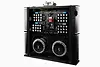
STAGE #3 MKII
The decisive step into a complete dual-chassis architecture. Stage #3 physically separates power from processing and introduces a dedicated power system, four independent lines, passive cooling and advanced network configurations.


SPECS
DUAL FULL-SIZE CHASSIS
The power supply is no longer an external module. It is half of the architecture, engineered to optimize every sound-affecting parameter more deeply.
One chassis houses the digital processing system. The other hosts the entire power architecture. Both measure 450 × 400 × 120 mm. More room to separate sections. More current capacity. More filtering. More control over the electrical and mechanical path.
The two chassis are connected by an umbilical cable terminated with a Harting multipole connector, fitted with a lock against accidental release. Stage #3 brings separation to its first full realization.
Two full-size chassis. Up to 20 amperes. Four independent lines. 29,900 µF of filtering. ECC on-die memory.
The soundstage gains order and depth. Instruments occupy more legible positions. The finest information emerges without aggression.
SEPARATION IS ONLY THE FIRST STEP. REFINING THE DESIGN OF WHAT HAPPENS NEXT RAISES THE LISTENING EXPERIENCE TO A HIGHER LEVEL OF FIDELITY.
Moving the power supply out of the main chassis reduces a major source of interference. But distance alone does not finish the job.
Still to be defined:
-
how much current must be available;
-
how to distribute it;
-
which sections must remain independent;
-
how much filtering to employ;
-
how to organize the circuits;
-
how to control cabling and vibration;
-
how to manage heat, network and software activity.
Stage #3 MKII was born to develop and control each of these elements within a true dual-chassis architecture.
POWER SUPPLY
Twenty amperes in reserve. Four independent paths.
The Stage #3 MKII power unit can deliver up to 20 amperes in total. Current is distributed through four fully independent lines, fed by two Audio Grade toroidal transformers. Each line serves specific sections of the machine, limiting electrical interaction between components with different functions and demands. The current reserve is not used as brute force. It keeps the supply stable when the processing load varies and the system faces complex content, large libraries or demanding audio processes.
FILTERING
29,900 µF. Not to pile up numbers. To stabilize the system.
The filtering system reaches a total of 29,900 µF. It employs ELNA, Rubycon and Epcos capacitors, and high-precision Dale resistors with 0.1% tolerance.
But filtering capacity is not everything: it works together with the separation of the lines, the quality of the transformers, the layout and the electrical paths.
None of these elements can be judged in isolation. It is their relationship that determines the stability of the power supply and the amount of noise reaching the digital sections. Stage #3 is designed following exactly this approach.
THE LINK BETWEEN THE CHASSIS
Separate physically. Unite electrically, without losing control.
The connection between power unit and Music Server is a critical point of the architecture. Moving the transformers out of the main chassis is not enough. Energy must be transferred through a path that is stable, safe and consistent with the system's current capacity. This is why Stage #3 uses a Harting multipole connection with a locking mechanism. Even the way the cable is assembled and routed is part of the design. Physical separation creates value only when the electrical link is treated with the same discipline.
MECHANICAL CONTROL
The signal is digital. But the machine that carries it still obeys the laws of matter.
Stage #3 MKII uses feet machined from solid aluminum, contributing to the unit's stability and to the management of stresses transmitted by the supporting surface. Particular attention is also devoted to:
-
component placement;
-
the assembly of internal wiring;
-
the connection between the two chassis;
-
the reduction of unnecessary paths;
-
the control of vibration transmitted by surfaces and by the environment.
THERMAL MANAGEMENT
Stage #3 MKII is cooled by fully passive technology.
The two full-size chassis offer more volume and surface area to organize heat dissipation and keep components within their intended operating conditions.
The absence of forced ventilation eliminates mechanical noise in the listening room.
But the real goal is not only audible silence. It is keeping the machine stable without introducing a new source of vibration.
PROCESSING AND AUDIO ENGINE
The engine you prefer. A machine built to let it work in the best conditions.
Stage #3 MKII uses an Intel architecture selected to work effortlessly with advanced playback software, extensive libraries and high-resolution audio processing. It integrates 16 GB of memory with ECC on-die technology, contributing to data-integrity control and operational stability.
Sound quality emerges from the relationship between power, processing, memory, temperature, operating system and interfaces. Stage #3 is designed to control each of these domains.
The system is configured around your listening.
Stage #3 MKII supports the leading software and services dedicated to digital playback:
-
Roon;
-
HQPlayer;
-
Qobuz Connect;
-
Tidal;
-
JRiver;
-
Spotify Connect;
-
Pure ASIO Player.
We recommend HQPlayer, also in combination with Roon, whenever the DAC and the system can benefit from its processing capabilities. Playback can be managed from tablet and smartphone through the app provided by your chosen software. We also guide our customers in choosing the best software for them, based on library, DAC, services used and desired level of control. On delivery, the system is already configured.
NETWORK
One network. Or two physically independent paths.
Stage #3 MKII integrates a 2.5GbE Ethernet connection. On request, it can be configured with two fully independent network cards. This architecture makes it possible to separate different functions, for example dedicating:
-
one port to the home network and streaming services;
-
a second to the NAS;
-
or a dedicated connection to a compatible network DAC.
The dual interface is not about nominal speed. It is about reducing sharing between paths and devices performing different tasks. The network is treated as part of the source, not as an IT add-on.
OPERATING SYSTEM
Straight from the professional environment. Radically optimized for high-fidelity playback.
The same OS on which the masters of virtually every record released in the last forty years have been - and still are - professionally produced.
The privilege Linux cannot offer: full use of the proprietary ASIO drivers that DAC manufacturers write to let their customers extract the maximum from their own machines.
We also tested the minimalist route: NUC, Raspberry Pi, Linux variants. But the sound lacked vitality.
After years of testing, we selected a single Windows build - LTSC - and optimized it function by function, parameter by parameter, exclusively for audio.
CONNECTIONS AND FORMATS
-
2.5GbE Ethernet;
-
USB Type-C;
-
USB 3.2 Type-A;
-
optical S/PDIF;
-
coaxial S/PDIF;
-
I²S on request.
-
PCM up to 192 kHz, 24 or 32 bit;
-
DXD up to 352.8 and 384 kHz;
-
DSD64, DSD128, DSD256 and DSD512.
STORAGE
Local files, NAS and streaming in the same system.
Stage #3 MKII includes 4 TB of internal storage as standard, expandable to 20 TB. You can keep your library inside the machine, play content from a NAS, or use streaming services. The different sources come together in a single control experience — without giving up ownership of your files, and without depending solely on an external connection.
BUILT FOR YOUR SYSTEM
Every Stage #3 MKII is built and configured individually. Before building, we analyze:
-
DAC;
-
digital interface;
-
network;
-
NAS;
-
library;
-
software;
-
streaming services;
-
processing needs;
-
control preferences.
On request, storage, memory, network interfaces and other parameters compatible with the architecture can be customized. Customization does not mean adding options indiscriminately. It means avoiding unnecessary components and configuring the necessary ones around your needs.
HAND-BUILT IN ITALY. CONFIGURED BY TDA.
Every Stage #3 is built by hand, individually, in Italy.
Manual construction allows us to control what standardized production tends to ignore: cable routing, mechanical couplings, software configuration and the overall behavior of the machine.
Each unit is built, configured, calibrated and tested before shipping.
On delivery, we personally take care of:
-
installing Stage #3 MKII in your system;
-
configuring the network;
-
connecting the DAC;
-
setting up the playback software;
-
importing or indexing the library;
-
a complete guide to operation.
As a TDA customer you can also rely - beyond legal warranty - on included after-sales support, unmatched in the industry, comprising technical checks and software-side interventions performed directly through a secure remote connection, for maximum convenience and flexibility.
SUPPORT
Service completes the experience, redefining what Hi-Fi means.
The complexity stays with us. You simply enjoy the music like never before.
As a TDA customer you can count — beyond the statutory warranty — on included after-sales support, without equal in the industry, comprising technical checks and software-side interventions performed directly through a secure remote connection, for maximum convenience and flexibility.
_11zon_11zon%20(1).webp)
WHAT YOU WILL HEAR
The soundstage opens, and holds its shape at any volume.
Most systems sound refined until the music asks for everything at once.
Then the full orchestra arrives, or the band hits the chorus, and something quietly gives way: the stage narrows, instruments smear together, the crescendo loses its top.
Stage #3 doesn't do that.
Twenty amperes in reserve across four independent lines means the supply never caves in when the load shifts. What you hear is composure.
Dynamic swings land with their full force. The soundstage holds its shape at any volume. Dense passages stay readable - you can still follow the second violins with the whole orchestra playing.
Bass gains articulation, not quantity. The top end keeps its information without hardening. And the loudest passage in the recording becomes the one you stop bracing for.
You judge it in your own system,
With your own loudspeakers, your own DAC,
And the music you know inside out.
We bring demonstrations into the customer's own system wherever we can, or host them with our selected international partners.
The demo is free, with no obligation to buy.
To guarantee an impeccable experience we take a limited number of requests each month, handled in order of booking.
Your music. Your system. Your verdict.
01 — Technical consultation
30 minutes, phone or video.
We analyze your audio system and your listening room. DAC, network, present source, preferred player, connection architecture and the music used to judge it.
02 — Delivery and setup
In Italy, Stage is installed in your home by its designer - not by a courier.
Abroad, by your authorized distributor, where available.
03 — The direct comparison
Your current source, then the Stage you selected. Music you have known for years.
Enough time to hear every aspect of the change in performance.
04 — Your commission slot
You can commission your own, customized for your system: storage, color finish, and any other available bespoke option.
⠀ | Stage 1 | Stage 2 | Stage 3 | Stage 4 |
|---|---|---|---|---|
The entry into the discipline: A streamer receives music. A Stage governs it. | The power supply leaves the chassis. The signal gains space. The background disappears. | Separation becomes a complete architecture. The soundstage holds its shape and details at any volume. | Nothing between you and the recording. Engagement and sonic realism unmatched in its class and beyond. | |
Architecture | Single full-size chassis | Main chassis + compact external PSU | Two full-size chassis | Two full-size chassis |
Power supply | Low-ripple switching, built for the single-chassis equation | 3 independent linear lines · 2 toroidal transformers | Up to 20 A · 4 independent lines · 2 Audio Grade toroidals | Up to 20 A · 3 independent lines · 3 Audio Grade toroidals |
Memory | 8 GB ECC on-die | 8 GB ECC on-die | 16 GB ECC on-die | 16 GB ECC on-die |
Storage (standard → max) | 4 TB → 10 TB | 4 TB → 20 TB | 4 TB → 20 TB | 8 TB → 20 TB |
Network | 2.5GbE · AES67-optimized (RAVENNA / DANTE) | 2.5GbE · AES67-optimized (RAVENNA / DANTE) | 2.5GbE · second independent card on request · AES67-optimized (RAVENNA / DANTE) | Dual independent 2.5GbE · AES67-optimized (RAVENNA / DANTE) |
Digital outputs | USB · optical + coaxial S/PDIF · I²S on request | USB · optical + coaxial S/PDIF · I²S on request | USB · optical + coaxial S/PDIF · I²S on request | USB · optical + coaxial S/PDIF · I²S on request |
Mechanical control | Assembly discipline | Omicron decoupling, on request | Solid-aluminum machined feet | Patented, custom-built with Omicron resonance control feet |
Cooling | Fully passive | Fully passive | Fully passive | Fully passive |
Price | €5,390 | €6,950 | €9,200 | €12,500 |
.webp)
THE SERIES AT A GLANCE
€9,200.00

DISCOVER OTHER MODELS OF THE SERIES
_11zon.webp)
Presented at the Audio Video Show in Warsaw.
The most complete expression of the TDA discipline within the Stage series, turning your listening into an exclusive experience of engagement and sonic realism unmatched in its segment.
when the source stops being the limit, everything downstream is finally heard doing its best work — your DAC, your amplification, your speakers, lifted all at once.
What that sounds like is hard to describe and instant to recognize: instruments simply sound like themselves.
€12,350